
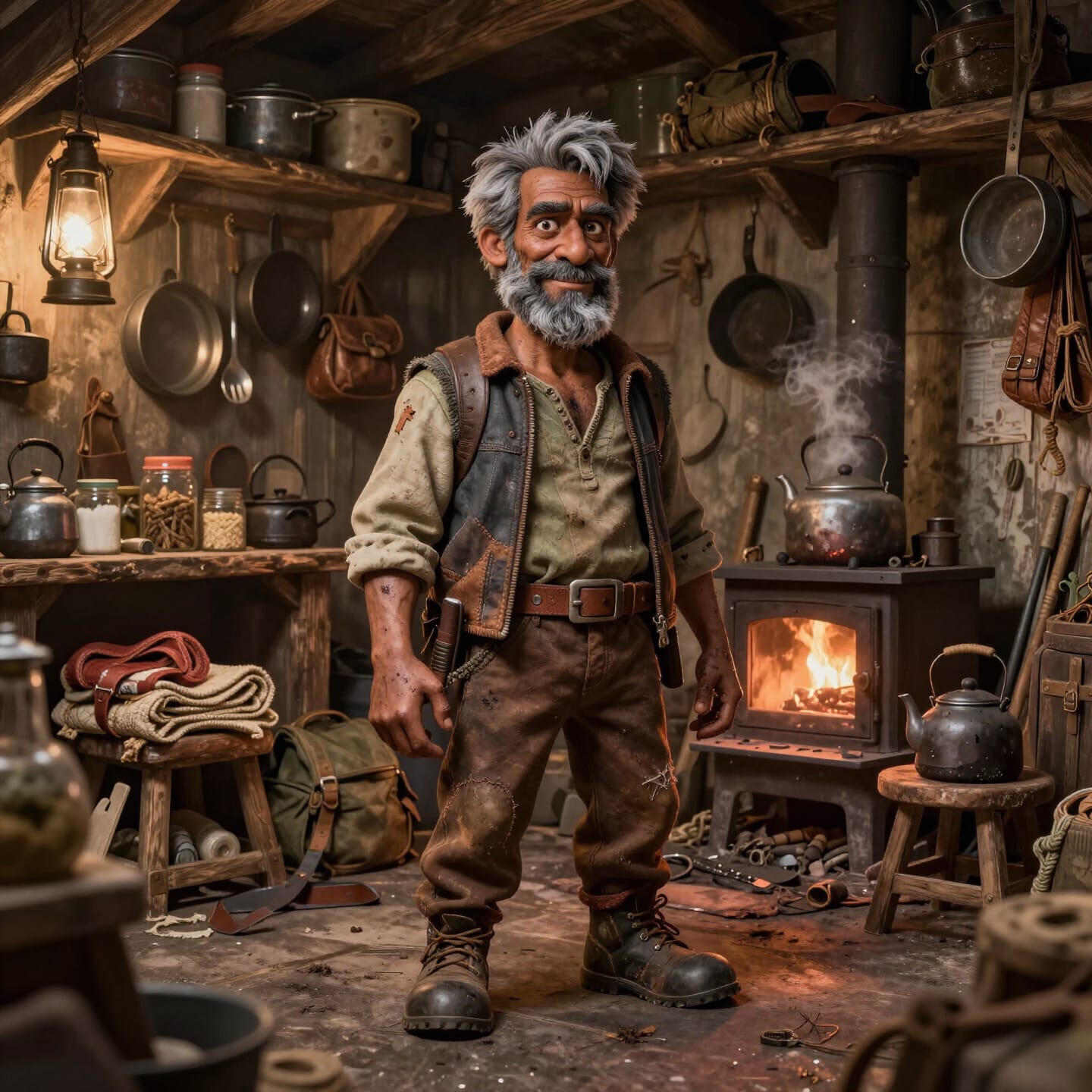
Conrad the Giant is a dear friend of mine, and I always enjoy trading gossip when I stop by for tea when I’m in the area.
Conrad is a gnome, and his name is an example of gnomish ironic humour. Conrad the Giant is small even by gnome standards, standing at just under 1 meter tall. During his adventuring days, Conrad amassed quite a collection of odds and ends and now runs a shop, “Conrad’s Cabinet of Curiosities”, selling these curiosities. He has a nice selection of mundane homewares for the locals in Drovers End, where his shop is, and carries some standard adventuring gear as well as assorted strange and curious goods. He also has a sideline as a tinker, repairing damaged wares for the locals. He also makes some of his own items to sell.
On one of my visits with Conrad, I asked if I could interview him for an article in one of my annuals. Conrad gracefully accepted, and so, over a pot of his special reserve tea, we began to converse.
J: “I hear you used to be an adventurer. How did you get into that?”
C: “Well, it was before The Brewers War, which brought so much destruction to this part of the world. I was, of course, younger and fond of rambling. I found myself in a small town, much like this one. I went to the inn to wet my whistle, and I know it’s cliched, but as fate would have it, we were all there at the same time, although all for different reasons. After a few rounds, we formed a strange sort of bond. And so it began. We all had different motivations for taking up the adventuring life, yet somehow all our goals aligned, and we formed a great team. The Mahmeds had fame and riches on their minds. They weren’t greedy; they just wanted to make a mark on the world. They weren’t married when we first established our team, but they grew close and married a few years later. St Augustus, the righteous do-gooder, wanted to bring justice for those who could not stand up for themselves. Ebon wanted to spread the word of their own god far and wide. Ironically, their god preached peace, which Ebon sought to bring with the business end of a hammer. Braken always sought to integrate disparate cultures in harmony. I never really understood Auman. She loathed crowds and confined spaces, yet she threw her lot in with our crew, never once complaining even while we pursued adventure in towns and cities, or delved into near forgotten underground ruins. I guess she found what she was looking for since she stayed with us until the team disbanded. Hanzo was relentless in her pursuit of her weapon smithing craft. Adventuring was a way for her to seek out new and novel materials and techniques of crafting. I just wanted to see the world and find shiny things.
Yet despite our different motivations, we all came from a place of good in our hearts, and that bound us all together. I like to think we left the world a better place.”
J: “Who named your group ‘The Order of the Coq’?”
C: “Oof. I think it started as a joke by Ahmed Mahmed, but somehow it stuck. I told them it was a terrible name, but I was outvoted. Even St Augustus supported it, but I think it’s because he’s just too straight to get the joke.
I understand the reasoning behind the name, but sometimes you just need a bit of a reality check, right? I mean ‘The Order of the Cock’? Seriously?
It’s supposed to represent the rooster who heralds the coming of the dawn and the end of the night. I quite like the sentiment, but couldn’t they have gone with ‘Order of the Rooster’, or something?”
J: “The Order lived in interesting times, during the Brewer’s War. What side did The Order take in the war?”
C: “Yes, ‘interesting’ is one word for it. We’d already been adventuring for a while before the war broke out. I know this isn’t supposed to be discussed in ‘polite society’, but we all know the Emperor used the trade imbalance between Sel Bartain and Letland as a pretext to launch the war. The Emperor was jealous of Letlands access to mineral wealth, so he invaded and seized those resources. You’d think that would make Sel Bartain the bad guys, even though they won the war, but what people tend to forget is that it’s the little people, on both sides of the conflict, who suffer the most. The farmers and traders in the countryside come off second best, no matter who’s winning the war. So we didn’t take any sides except perhaps the side of the common folk, and we operated on both sides of the battle lines.
Mainly, we tried to bring aid to the people who needed it the most. Augustus healed the sick and wounded. Ebon helped with the healing but also put their practical skills to good use, helping repair ruined houses and villages, and literally turning swords into ploughshares. The Mahmeds used their connections in upper society to quietly solicit donations to help feed the needy. The rest of us did what we could to bring a little light to the lives of the people in a dark time. It was gruelling work, and the common folk could only afford to pay us with gratitude, but that was enough for us.”
J: “What happened after the war? The Order seemed to just disappear.”
C: “After the war, we no longer had the heart for adventuring. Our priorities shifted, and we drifted apart. There was no animosity; things just changed.
Ahmed and Jasmin Mahmed inherited an estate from Jasmin’s family. They moved there, and from what I hear, they were benevolent and well liked nobility before they died peacefully of old age, which is probably the best death an adventurer could hope for. Apparently, their grandchildren didn’t inherit Jasmin and Ahmed’s graceful nature and are said to be greedy and avaricious.
St Augustus took up the mantle of guardian of a certain … ah … place … and remains there to this day. I drop in to see him now and again, but he’s not a great conversationalist these days. I suppose he never was unless you got him talking about his faith.
Apparently, Ebon hung up their hammer and founded a church preaching pacifism, where they have a small congregation to this day.
Braken became a trader of goods between an Orc collective and merchants in Sel Bartain and also operated as an unofficial envoy between the two groups. An extremist orc faction attacked his wagon train one day and murdered him and all his escorts. Those orcs claimed that Braken’s working with the humans was a betrayal of his orcish heritage. I later heard that those same murderous orcs all died a slow and agonising death from food poisoning. No one suspects that it was me who put the mushrooms in their coffee.
Auman drifted back into the wilderness, where she carved out her own territory, which she jealously guards.
Hanzo is training to take her journeyman exam. She is still too young to meet the guild’s minimum age requirement, but her skill already surpasses that of some of the masters. I suspect those same masters are jealous of her skill and will try to hinder her progress. But she’s a big girl and knows how to navigate politics.”
C: “It sounds like you’ve lived an eventful life. What are your plans for the future?”
J: “Hmm. The future, eh?
Well, I very much enjoy running my shop and have no immediate plans to stop doing so. This town sits close to the historical border between Sel Bartain and Letland and bore the brunt of the fighting. Even now, though the war was just over 100 years ago, this region is still recovering. I sell homewares and farming implements to the locals on the cheap. I operate at a loss selling to the locals, but I make up for it by gouging the adventurers who pass through.
Maybe one day I could move the shop somewhere else. Maybe someplace warmer.”